
Disclaimer: Crypto is highly volatile and you could lose all your money, do your own research before investing.
Key Takeaways
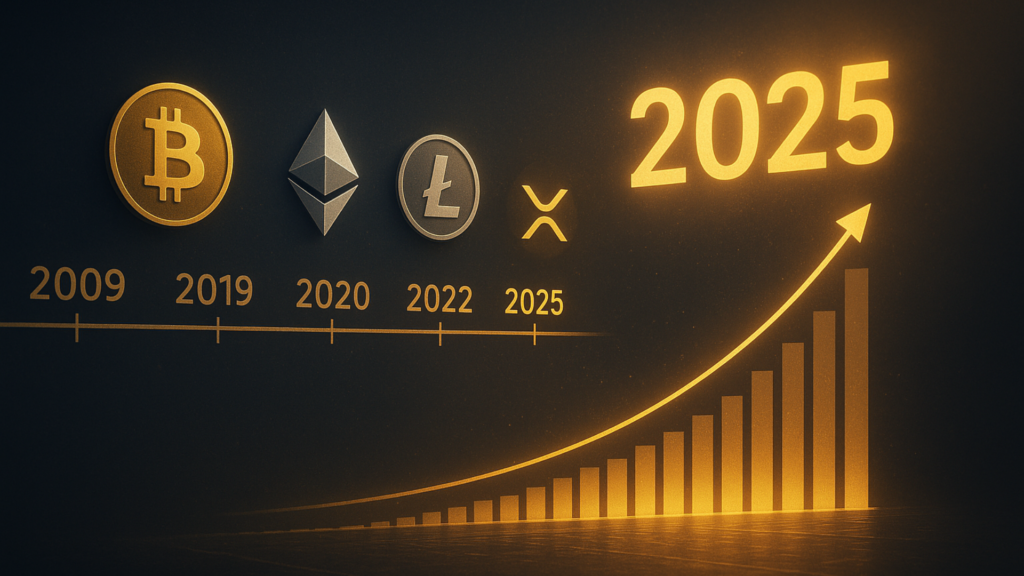
- 2025 has marked a defining point for the cryptocurrency industry, with unprecedented adoption, regulation, and technological progress occurring within a single year.
- Institutional investment has surged to record highs, driven by improved infrastructure, clearer compliance standards, and mainstream acceptance.
- Technological breakthroughs in blockchain scalability, interoperability, and energy efficiency have set new benchmarks for the industry.
- Global governments have shifted from an oppositional stance to active engagement, creating frameworks that balance innovation and investor protection.
- The rise of real-world crypto applications in finance, healthcare, supply chains, and entertainment has solidified blockchain’s role in the global economy.
Introduction
For over a decade, the cryptocurrency industry has experienced cycles of hype, skepticism, and steady development. Yet, 2025 stands apart as the year that crystallized its place in the global financial and technological landscape. Unlike earlier bull runs defined primarily by speculative mania, this year’s transformation has been marked by deep structural changes—regulatory integration, large-scale institutional adoption, and the seamless embedding of blockchain into everyday business operations.
Global financial institutions, tech giants, and even governments have not only acknowledged crypto’s legitimacy but have also committed capital, infrastructure, and policy support to its growth. The resulting environment is one of unprecedented momentum, where blockchain is no longer a niche experiment but a recognized pillar of the digital economy.
Institutional Capital Flooding the Market
One of the defining shifts in 2025 has been the sheer volume of institutional capital entering the crypto space. While 2020–2024 saw early forays from hedge funds and a few forward-thinking corporations, this year brought the full weight of traditional finance into the fold. Asset managers with trillions under management have rolled out dedicated digital asset funds, banks have integrated crypto custody into their core services, and pension funds have allocated small but significant percentages of their portfolios to blockchain-based investments.
Signup on Bybit and receive 100USDT as welcome bonus
These moves have not been driven purely by speculation but by clear market data showing cryptocurrency’s resilience as an asset class and its correlation benefits in diversified portfolios. As a result, the industry has experienced a dramatic increase in liquidity, stability, and credibility, shifting perceptions from “volatile gamble” to “strategic allocation.”
Regulatory Clarity and Government Engagement
If there has been one consistent barrier to mainstream adoption, it has been regulatory uncertainty. In 2025, however, major economies have moved from ambiguous or hostile stances to structured engagement. The U.S., European Union, and key Asian markets have rolled out comprehensive frameworks covering digital asset classification, taxation, anti-money laundering compliance, and consumer protection. This has provided businesses with the confidence to innovate without fear of sudden legal reversals.
Importantly, regulators have taken a collaborative approach, working with industry leaders to design rules that encourage responsible growth. This shift has also reduced the stigma surrounding crypto, making it easier for traditional enterprises and investors to participate. The end result is a more transparent, compliant, and investor-friendly environment that paves the way for sustained expansion.
Technological Breakthroughs Defining the Year
2025 has also been remarkable for the scale of technological innovation across blockchain networks. Scalability, once the Achilles’ heel of major chains, has seen exponential improvement thanks to advanced Layer-2 rollups, zero-knowledge proofs, and hybrid consensus mechanisms. Interoperability protocols have matured, allowing seamless asset transfers and smart contract execution across different blockchains without the inefficiencies of earlier bridging solutions. Energy efficiency has become a standard expectation, with most leading blockchains now operating at carbon-neutral or carbon-negative footprints.
Signup on Bybit and receive 100USDT as welcome bonus
This progress has not only silenced many environmental critiques but has also attracted ESG-conscious institutional investors who had previously avoided the space. The result is a technology stack capable of supporting billions of daily transactions without compromising speed, cost, or security—unlocking use cases once thought impossible.
Mainstream Consumer and Enterprise Adoption
Beyond investor enthusiasm, 2025 has been the year when blockchain truly entered everyday life. Financial institutions now offer crypto-backed debit cards, enabling seamless spending at traditional retailers. Stablecoins have become standard tools for remittances, allowing migrant workers to send money home instantly and at minimal cost. In healthcare, blockchain-based medical record systems are being adopted by national health services, enabling secure patient data management across borders.
Supply chains across industries—from agriculture to aerospace—are using distributed ledgers for real-time tracking, fraud prevention, and compliance reporting. Even in entertainment, NFT technology has matured beyond speculative art trading, providing artists and production companies with dynamic royalty tracking and fan engagement tools. These developments have turned blockchain from a niche interest into a critical infrastructure layer for global commerce.
Shifting Global Economic Dynamics
The rise of crypto in 2025 has not been an isolated technological trend but part of a larger rebalancing of global economic power. Emerging markets, historically disadvantaged by limited access to global finance, have embraced blockchain-based payment and lending systems to bypass traditional banking limitations. Countries facing currency instability have turned to digital assets as a hedge against inflation, while others have issued fully interoperable central bank digital currencies (CBDCs) that coexist with decentralized cryptocurrencies.
The interplay between sovereign digital currencies and public blockchains has created a more fluid and inclusive global financial system, where participation is no longer gated by geography or local banking infrastructure. This reconfiguration of economic connectivity is perhaps one of the most transformative aspects of the year.
The Role of Education and Public Perception
Another key factor in 2025’s breakthrough has been a shift in public perception, supported by widespread education initiatives. Universities now offer accredited blockchain degrees, high schools teach basic crypto literacy, and online platforms host millions of participants in decentralized finance (DeFi) simulations. This broad-based understanding has dispelled many myths, replacing fear of the unknown with informed engagement.
As people better understand how to use, secure, and benefit from blockchain, adoption has spread far beyond the tech-savvy early adopters. Media coverage has also matured, with reputable outlets providing balanced reporting instead of sensationalist headlines, further normalizing crypto’s place in public discourse.
Resilience Through Market Volatility
While 2025 has been a landmark year, it has not been without turbulence. Price swings, protocol hacks, and speculative bubbles have occurred, reminding participants that the market remains volatile. However, the response to these challenges has underscored the industry’s newfound maturity. Recovery times after incidents have been dramatically shorter, investor protections have been swiftly deployed, and insurance protocols for DeFi have proven effective at compensating affected users.
This resilience has strengthened confidence among stakeholders, demonstrating that the industry is now capable of absorbing shocks without descending into chaos. Rather than deterring adoption, these stress tests have reinforced the notion that crypto is evolving into a durable, self-sustaining ecosystem.
Conclusion
As the dust settles on this extraordinary year, it is clear that 2025 will be remembered as the inflection point when cryptocurrency transitioned from emerging technology to established global infrastructure. Institutional capital has provided the stability and scale needed for mass adoption, while regulatory clarity has legitimized the industry in the eyes of both businesses and consumers. Technological breakthroughs have removed longstanding barriers to performance and sustainability, enabling blockchain to power real-world solutions across nearly every sector.
Most importantly, public understanding and global economic integration have ensured that this growth is not merely a temporary boom but the foundation for decades of innovation. The lessons of 2025—collaboration, scalability, and responsible adoption—will shape the trajectory of the crypto industry for years to come, making it not just a remarkable chapter in digital finance but the year that defined its future.